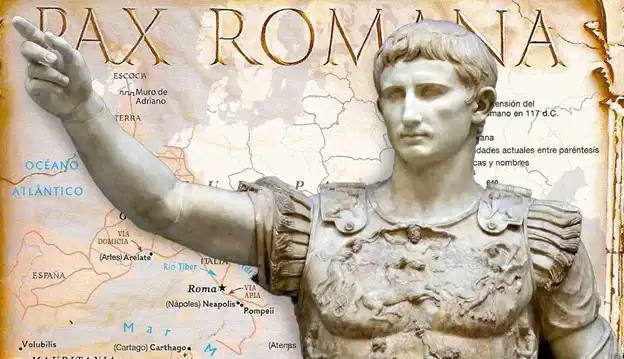
If you lived in the Roman Empire during the first two centuries after the birth of Christ, you might have felt pretty lucky. The roads were safe, trade was booming, and the empire stretched across much of Europe, North Africa, and the Middle East. Historians later gave this long stretch of stability a name: the Pax Romana, meaning “Roman Peace.”
But before we imagine Romans peacefully sipping wine in their villas forever, we should pause. Roman peace did not necessarily mean quiet or calm. Sometimes it meant that Rome had already conquered everyone who might cause trouble. As the historian Tacitus once sarcastically wrote, “They make a desert and call it peace.”
Still, compared with the chaos that came before, the Pax Romana really did feel like a golden age. The period usually begins in 27 BCE, when Octavian, better known as Augustus, became Rome’s first emperor. After decades of civil wars that had torn the Republic apart, Augustus promised stability. His message to Rome was simple: no more civil war, no more political chaos. In exchange, he would hold most of the power.
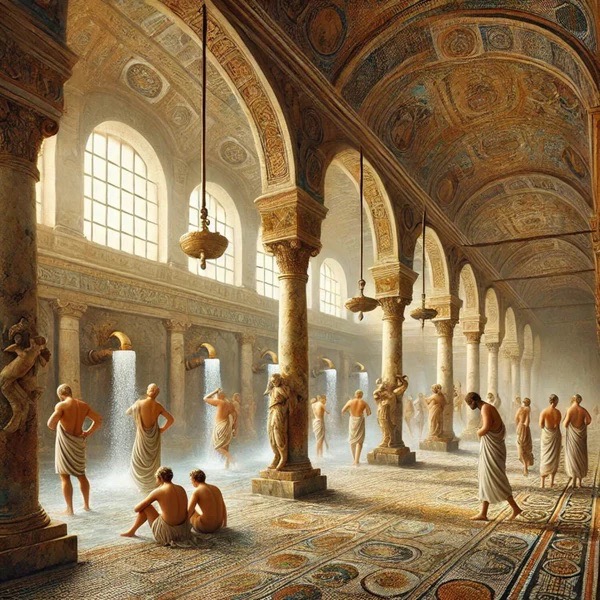
Many Romans accepted this deal happily. After all, peace sounded much better than constant political violence. Augustus carefully maintained the appearance of the old Republic, calling himself princeps (“first citizen”) rather than king. But everyone understood who was truly in charge. Under Augustus and his successors, Rome prospered. The empire built thousands of miles of roads so well designed that parts of them still exist today. Merchants traveled across the Mediterranean carrying wine, olive oil, grain, spices, and silk. Roman soldiers guarded the borders, while engineers constructed aqueducts, bridges, and cities.
You could travel from Britain to Egypt along Roman roads, stopping at inns along the way. Latin spread across the western empire, Greek remained dominant in the east, and Roman law helped organize daily life. The empire even maintained a professional fire brigade in Rome, an impressive improvement over the earlier strategy of “run and hope the fire stops.” In many ways, the empire functioned like a giant machine. Taxes flowed in, armies guarded the frontiers, and the emperors worked hard to keep things stable. Emperors such as Trajan, Hadrian, and Marcus Aurelius ruled during what historians sometimes call Rome’s “Five Good Emperors.” Their reigns were relatively peaceful and competent—always a welcome combination in politics.
Yet even during the Pax Romana, things were not perfectly calm. There were rebellions, political conspiracies, and the occasional emperor who behaved more like a dramatic theater actor than a responsible ruler. (Looking at you, Nero.) The real cracks began to appear after Marcus Aurelius died in 180 CE. His son Commodus became emperor, and unfortunately, he did not inherit his father’s wisdom. Instead, he preferred gladiator games and self-promotion. Stability began to weaken. Over the next century, Rome faced serious problems. Emperors were assassinated or overthrown at an alarming rate. Armies often declared their own generals emperor, leading to civil wars. The economy struggled with inflation, and maintaining such a massive empire became expensive.
At the same time, pressure increased along Rome’s borders. Germanic tribes pushed into Roman territory, while conflicts with the Persian Empire in the east drained resources. What had once been strong frontiers slowly became harder to defend. By the third century CE, historians describe a period called the “Crisis of the Third Century.” During this time, the idea of Roman peace felt more like a distant memory. Emperors rose and fell rapidly, regions briefly broke away from imperial control, and instability spread across the empire.
In truth, the Pax Romana ended because the system that created it could not last forever. The empire depended heavily on strong emperors, loyal armies, and steady economic growth. Once those pillars weakened, the structure began to shake.
Yet the legacy of the Pax Romana remains remarkable. For nearly two centuries, a vast empire managed to maintain relative stability across three continents. Not bad for an empire that started as a small city on the banks of the Tiber.
As the Romans might say, sic transit gloria mundi - “thus passes the glory of the world.”