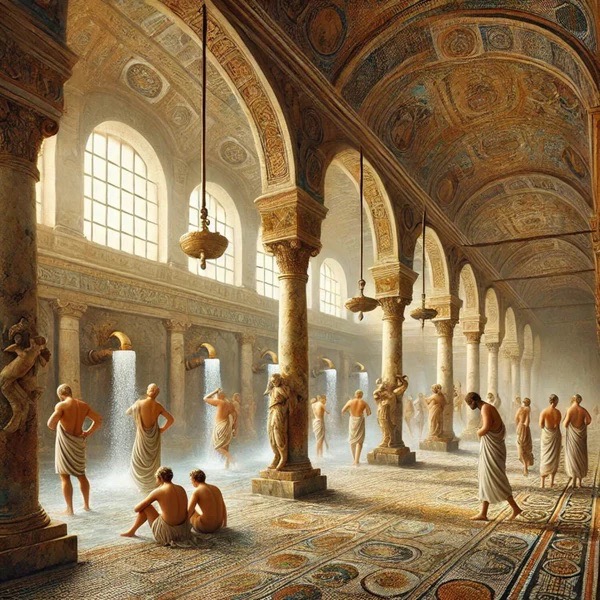
In today’s modern world, if you wish to find good conversation and a game, you might go to a bar or pub. In ancient Rome, it was all about the public baths. Thermae were public bath houses where the residents of the Roman Empire would strip naked and relax, sharing the waters with friends and strangers alike. Thermae were grand structures with colorful mosaics, which could accommodate many bathers at a time. Prime examples of this were the Baths of Diocletian, which could service three thousand visitors at a time, and Trajan’s Baths of Rome, which could at times reach eight thousand visitors a day. Why was there such an interest in public bathing? It was fun. Romans would gather not just to wash away the dirt and grime of the day, but to converse, argue politics, read, play games, make business deals, or even to find a lover.
The thermae consisted of multiple parts. The apodyterium was the ancient equivalent of a modern-day locker room where bathers could disrobe and leave their personal belongings. This made it a popular place for thieves. Archaeologists have found approximately one-hundred thirty tablets made of lead or pewter called defixiones at Aquae Sulis in Bath, England, where bathers cursed those who had stolen their belongings and prayed for the return of their possessions. One such inscription translation reads, “Docilianus, son of Brucerus, to the most holy goddess Sulis. I curse him who has stolen my hooded cloak, whether man or woman, whether slave or free, that … the goddess Sulis inflict death upon … and not allow him sleep or children now and in the future, until he has brought my hooded cloak to the temple of her divinity.” Did the goddess Minerva Sulis hear their prayers? Did any of these curses come to fruition? Only the thief may know, as the results are lost to history.
Once the bathers had disrobed, they would then sojourn to the palaestra, or gymnasium, to exercise. After working up a sweat in the gym, Romans could swim in the natation, an open-air swimming pool, then proceed to the laconica (a heated dry room) and the sudatoria (sauna-style sweating room). Next, bathers would enter the caldarium, where they would take the plunge into heated waters warmed from the hypocaust system below. Think hot tub, ancient Roman edition. Languid and relaxed, they would move to the tepid lukewarm waters of the tepidarium, before finally taking a cold plunge into the aptly named Frigidarium. Polar Bear Club, anyone? This would often times be followed with a professional massage by a masso or aliptes, using scented oils such as lavender or myrrh. Completed, these steps would be repeated in reverse order before donning one’s clothes once more, ready to face the world refreshed.
Irrespective of demographic or gender, the Roman bath houses were open to all. While it was customary to charge a small fee, patrons would, at times, such as on public holidays, sponsor a free day at the baths. While primarily used for their baths, some thermae also included gardens, libraries, lecture halls, and public toilets. Imagine going through the multi-step process of bathing, then having to use the facilities to relieve yourself, and the only “toilet paper” available is a sponge on a stick that has been used by everyone before you in an era before an understanding of proper sanitation. That was the ancient Roman public toilet. In spite of the potential for unsanitary encounters, bath houses remained an important aspect of ancient Roman culture until after their decline.
So were Roman baths about cleanliness or social networking? The answer is both. Romans certainly valued hygiene, but they valued community just as much. In a world without smartphones or group chats, the bathhouse served as Rome’s daily gathering place. In other words, long before social media, Romans already knew how to stay connected - one bath at a time.