If you ask ten people in ancient Rome what they thought about Julius Caesar, you might get ten very different answers. Some would say he was a hero who saved Rome from chaos. Others would say he was a dangerous man who destroyed the Republic. And a few might whisper nervously, “Well… he did both.”
Julius Caesar remains one of the most famous figures in world history. His name became so powerful that later rulers used it as a title. The German word Kaiser and the Russian Tsar both come from “Caesar.” Not bad for someone who started his career deeply in debt.
Caesar was born in 100 BCE into a respectable but not extremely powerful Roman family. Like many ambitious young Romans, he wanted gloria - glory and political success. Rome at the time was technically a republic. It had elections, a Senate, and laws meant to prevent any one man from becoming king. Romans were proud of this system and often reminded themselves: “Rex Romae non erit.” - “There will be no king in Rome.”
But the Republic had problems. Politics had become messy, competitive, and sometimes violent. Powerful generals controlled loyal armies, and elections were often influenced by money and personal alliances.
Caesar proved to be exceptionally good at playing this political game.
His real rise to fame came during his military campaigns in Gaul (modern France). For nearly a decade, he fought battles, expanded Roman territory, and wrote dramatic reports about his victories in his famous work Commentarii de Bello Gallico. One famous line sums up his speed and confidence: “Veni, vidi, vici.” - “I came, I saw, I conquered.”
Back in Rome, however, the Senate was becoming nervous. Caesar was gaining enormous popularity with the people and loyalty from his soldiers. Many senators feared that he might become too powerful. In 49 BCE, the tension reached its breaking point. The Senate ordered Caesar to disband his army and return to Rome as a private citizen. Caesar faced a choice: obey the Senate and lose his power, or challenge the Republic itself.
Standing at the small river that marked the boundary of Italy, Caesar made one of the most famous decisions in history. He crossed the Rubicon River with his army and reportedly said, “Alea iacta est.” - “The die is cast.” Civil war followed.
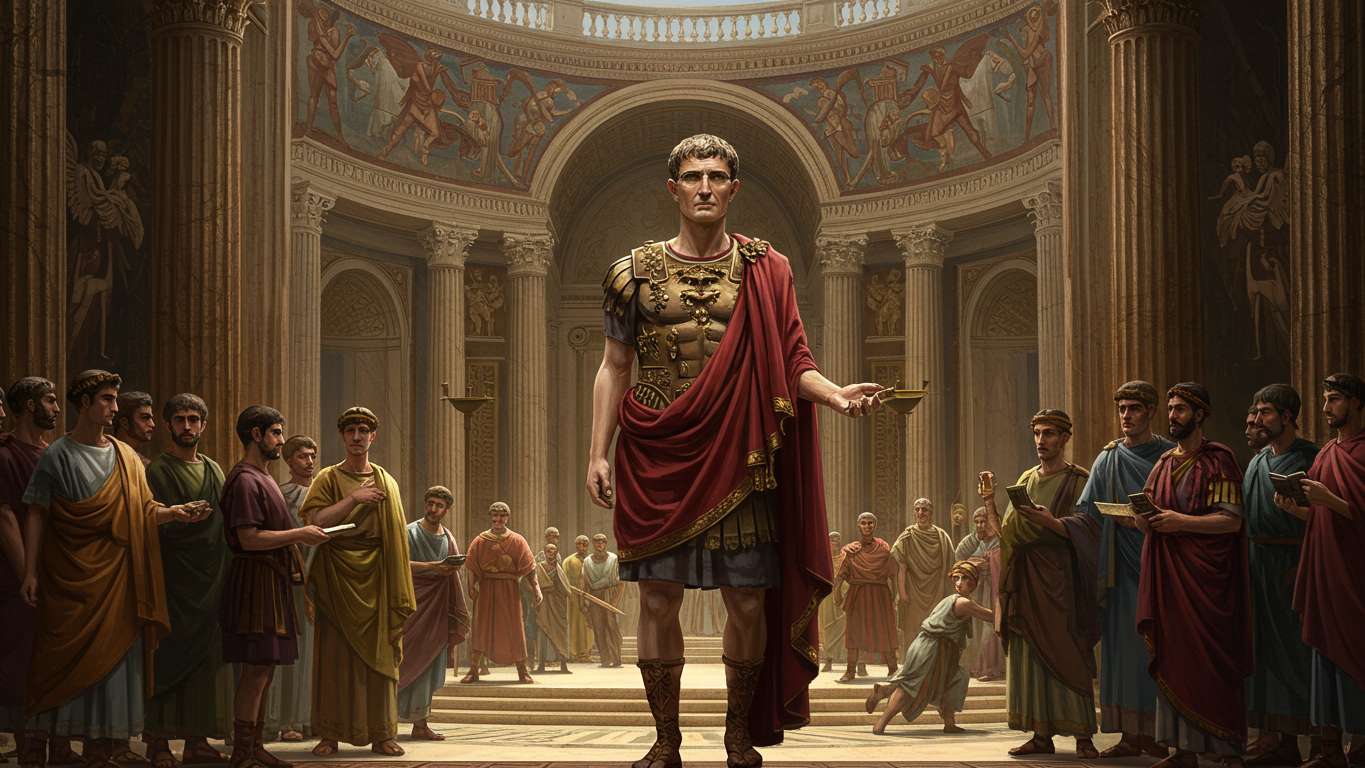
Caesar eventually defeated his rival Pompey and became the most powerful man in Rome. The Senate named him dictator perpetuo - dictator for life. To many Romans, this sounded dangerously close to monarchy.
Still, Caesar was not simply a power-hungry tyrant. He passed important reforms. He reorganized the calendar (creating the Julian calendar), reduced debt, expanded citizenship, and started public building projects. Many ordinary Romans admired him because he seemed willing to challenge the elite Senate.
But to some senators, Caesar had gone too far. Rome had overthrown kings centuries earlier, and they feared Caesar was bringing monarchy back. On March 15, 44 BCE, the famous Idus Martiae (Ides of March - a group of senators led by Brutus and Cassius assassinated him inside the Senate chamber.
According to tradition, Caesar’s final words were “Et tu, Brute?” - “You too, Brutus?”
Ironically, the assassins believed they were saving the Republic. Instead, Caesar’s death triggered another round of civil wars. Within a generation, Rome would no longer be a republic at all. It would become an empire ruled by Caesar’s adopted heir, Augustus.
So was Julius Caesar a hero or a dictator?
The truth is complicated. Caesar was brilliant, ambitious, and charismatic. He helped shape Rome’s future but also weakened the political system that had governed it for centuries. In other words, Caesar may not have planned to destroy the Republic, but his success made it almost impossible for the Republic to survive.
Or as some Romans might have sighed afterward: “Sic transit res publica.” - “Thus passes the Republic.”