If you walked through the streets of Rome on the morning of a big race day, you would feel the excitement in the air long before you reached the stadium. Vendors were shouting, people were arguing about their favorite teams, and thousands of Romans were rushing toward one place: the Circus Maximus. In many ways, it was the ancient world’s version of the Super Bowl — loud, crowded, dramatic, and absolutely impossible to ignore.
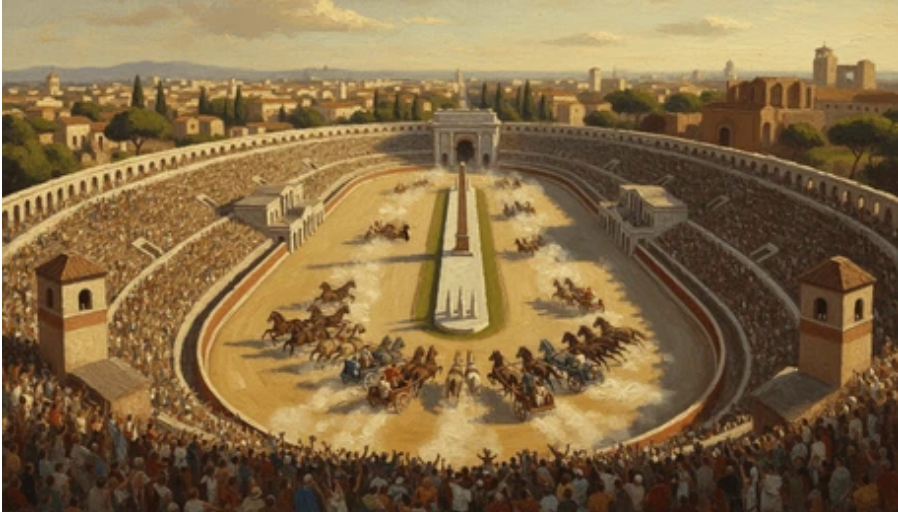
The Circus Maximus was the largest stadium in ancient Rome. Located in the valley between the Palatine and Aventine hills, it could hold more than 150,000 spectators. Some historians even think the number may have been closer to 200,000. That is far bigger than most modern sports stadiums. When races were held, the stands filled with citizens, senators, merchants, soldiers, and enslaved people. For a few hours, everyone in Rome gathered together for the same purpose: entertainment.
The main event at the Circus Maximus was chariot racing. Imagine small, lightweight chariots pulled by teams of horses, racing around a long oval track at incredible speeds. The drivers, called aurigae, were not always wealthy aristocrats. In fact, many of them started as enslaved people or came from humble backgrounds. But the best racers could become celebrities. Fans followed them closely, cheered for them loudly, and sometimes even placed bets on the outcome.
The races themselves were intense. The track had a long central barrier called the spina, decorated with statues and monuments. Racers had to complete seven laps around it, turning sharply at the ends. Those turns were dangerous. Chariots could crash, horses could collide, and drivers could be thrown into the dust. The crowd loved the danger as much as the speed. Every race carried the thrill of victory and the risk of disaster.
Roman fans were also fiercely loyal to their teams. These teams were known as factions, and each one had a color: Red, White, Green, and Blue. Supporters wore their team colors proudly and argued passionately about which faction was the best. If this sounds familiar, it should. Modern sports fans behave in almost exactly the same way. Romans shouted, celebrated, complained about bad calls, and bragged when their team won. In other words, they were not very different from fans today.
The energy inside the stadium must have been incredible. Imagine tens of thousands of people cheering, horses pounding the ground, dust rising into the air, and trumpets announcing the start of the race. When the gates opened and the chariots burst forward, the crowd roared. It was pure excitement.
Roman writers sometimes criticized this obsession with entertainment. The satirist Juvenal famously complained that the people cared about nothing except panem et circenses —“bread and circuses.” In other words, as long as the government provided food and entertainment, many citizens stopped worrying about politics. The Circus Maximus was not just about sports; it was also part of how Roman leaders kept the public happy.
But for ordinary Romans, the races were something more simple: fun. Life in ancient Rome could be difficult and stressful. A day at the Circus offered a chance to forget problems and enjoy the excitement of the moment. As one famous Latin phrase reminds us, carpe diem — “seize the day.”
So while the Super Bowl lasts only one evening, the spirit behind it is surprisingly ancient. Two thousand years ago, Romans were already gathering in massive stadiums, cheering for their favorite teams, arguing about the results, and celebrating the thrill of competition. Some things, it seems, never really change.