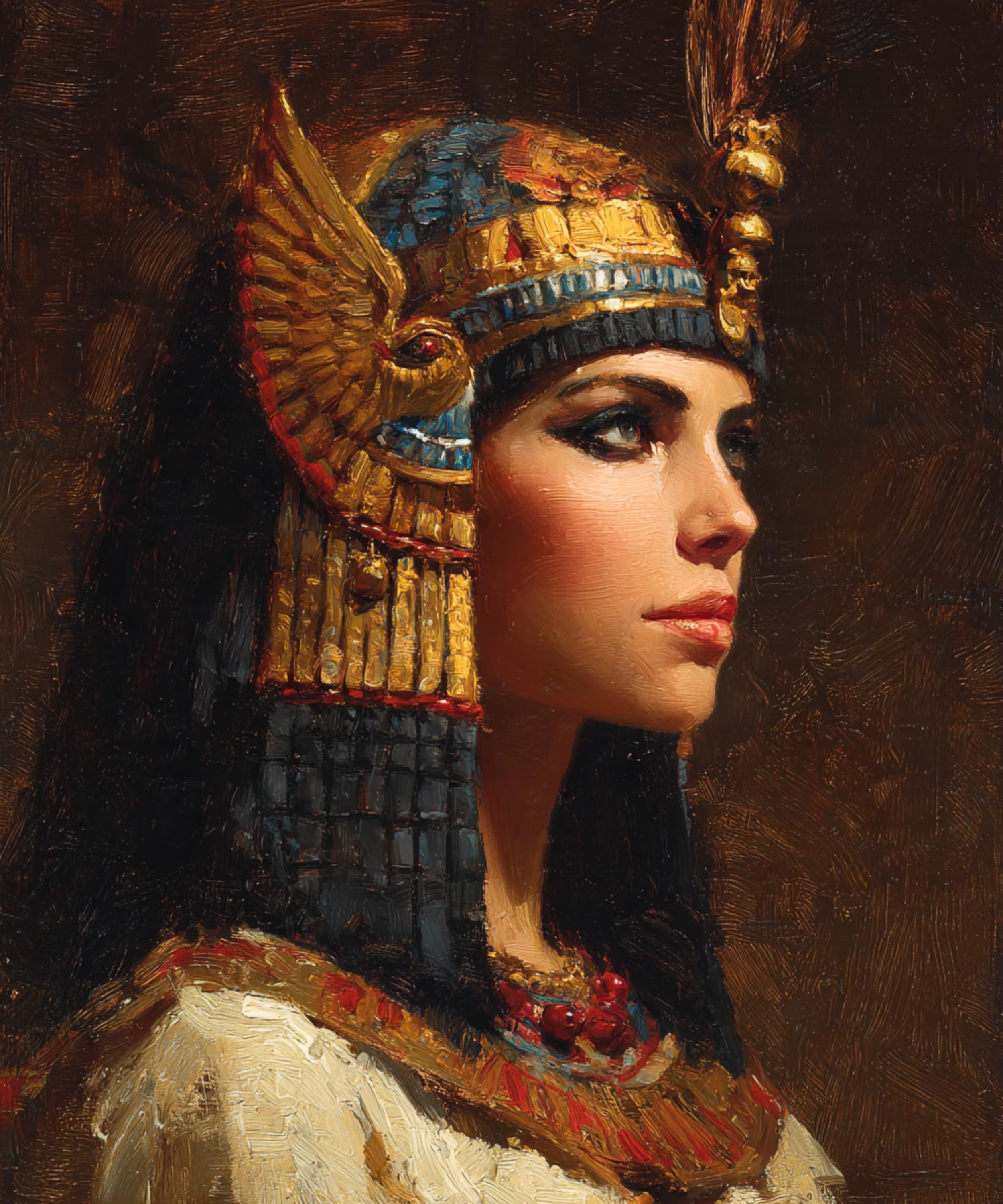
Cleopatra, a name that evokes thoughts of power, beauty, and ambition, remains one of the most significant figures in human history, her legacy continuing to be studied over two millennia since her death. Her intelligence and aspirations led her to be seen as both a viper and temptress who could make even the greatest men bend to her will. But was this true?
Cleopatra VII Philopator was born in 69 BCE into the royal family of Egypt, a descendent of the Ptolemaic Dynasty of Greek and Macedonian heritage. After the death of her father, Pharaoh Ptolemy XII Auletes in 51BCE, Cleopatra became Queen and married her younger brother Ptolemy XIII (as was tradition, yuck).
A woman of intelligence, Cleopatra had mastered multiple languages, and although the people loved her, her court feared and resented her. Her ambassadorial and linguistic prowess allowed her to speak directly with diplomats, much to the ire of her counsel. Cleopatra’s independence led General Achillas, Pothinus, and Theodotus of Chios to eventually overthrow her in 48BCE and install her brother-husband to rule, forcing Cleopatra and her half-sister Arsinoë to flee.
Shortly after Cleopatra’s departure, Pharaoh Ptolemy had Roman Republic general and politician Pompey the Great killed. Pompey had come to Egypt for help after being defeated by Gaius Julius Caesar, the newly established Dictator of Rome. Caesar arrived in Egypt and declared martial law, capturing the young pharaoh. Cleopatra saw this as a way to return to power.
Caesar and Cleopatra bonded over ambitions of power and conquest, and Cleopatra knew the only way to maintain her power and Egypt’s independence was to use her intellect and her beauty to situate herself with Caesar. An alliance would be wiser than war, and good relations meant trade and opportunity. The two quickly became lovers, much to the ire of her brother-husband Ptolemy XIII, and Caesar restored Cleopatra to Egypt’s throne.
War broke out, and Cleopatra convinced Caesar to help her fight Ptolemy, who died in 47 BCE, fleeing the Roman reinforcements. Arsinoë was seen as a threat to her power, and Cleopatra used the Roman legions to capture her sister, who was sent to Rome as a prisoner. Caesar exiled Arsinoë to the Temple of Artemis at Ephesus.
In the summer of 47BCE, Cleopatra bore Caesar a son, Ptolemy XV, or Caesarion, and established him as her heir. Cleopatra traveled to Rome to be Caesar’s consort, and while she was adored by the Roman people, the Senate, however, saw her as but another problem in controlling Caesar.
Caesar’s assassination on March 15th, 44 BCE, changed everything for Cleopatra, who fled back to Alexandria to escape a similar fate. After Caesar’s confidant and ally, triumvir Mark Antony, defeated the assassins at the Battle of Phillipi, he was named ruler of the eastern provinces and asked for Cleopatra to meet him. A woman not to be summoned, Cleopatra made it clear she would arrive when she chose.
Cleopatra designed her eventual appearance in Tarsus to be elegant, luxurious, breathtaking, and magnificent. Meeting Mark Antony, she did so clothed in fine gold and silk trappings, adorned as the goddess Venus. Mark Antony was immediately enamored by the Egyptian ruler, who knew to win Mark Antony’s heart would not only protect her but also form an alliance.
In 41BCE, Cleopatra saw the opportunity to finally get revenge on Arsinoë, who still had some favor in Egypt. Cleopatra convinced Mark Antony to assassinate Arsinoë. Arsinoë was attacked on the steps of the Temple, murdering her on sacred ground. Arsinoë’s slaying was blatant disregard to Roman temple customs, and the killing sent shockwaves throughout Rome.
In order to marry Cleopatra, Mark Antony divorced his wife Octavia in 32BCE, who was the sister of Octavian, the future Emperor of Rome. Fury towards Cleopatra continued to grow, particularly after Mark Antony and Cleopatra had three children together, and Octavian became tired of Mark Antony and his disrespect. Civil war erupted, and following a brutal defeat in 31BCE at the Battle of Actium, time had run out on Cleopatra and Mark Antony.
In the summer of 30BCE, as the Roman legions under Octavian took Egypt, Mark Antony received word Cleopatra had been killed. He stabbed himself, only to learn that she was alive. He died beside his beloved, and Octavian demanded surrender. Cleopatra, unable to find her way out of the situation, asked for a moment to prepare herself. When given privacy, Cleopatra poisoned herself (or, according to legend, allowed a venomous viper to bite her breast) and died.
Yet her story did not end there. For centuries, Roman writers shaped Cleopatra’s legacy as a woman whose beauty controlled powerful men. But modern historians increasingly recognize her as something far more impressive: a capable ruler navigating one of the most dangerous political environments in history. Cleopatra ruled during the final collapse of the Roman Republic, a time when even Roman leaders struggled to survive. That she managed to hold power for two decades, maintain Egypt’s wealth, and remain a central figure in Mediterranean politics speaks to her remarkable ability.
In the end, Cleopatra was not simply a seductress. She was a strategist, a diplomat, and a queen determined to protect her kingdom. As the Romans said, fortuna audaces iuvat — fortune favors the bold. And Cleopatra, without question, was bold.
References
Freeman, Charles. “Egypt, Greece, and Rome: Civilizations of the Ancient Mediterranean.” Second Edition. Oxford: Oxford University Press, 2004.
Mark, Joshua J. “Cleopatra VII: the Last Great Pharaoh of Ancient Egypt.” World History Encyclopedia.
Shaw, Ian. “The Oxford History of Ancient Egypt.” Oxford: Oxford University Press, 2004.